


 09/19/2025 - 02:42 AM

Chicago - Special to the Beirut Times
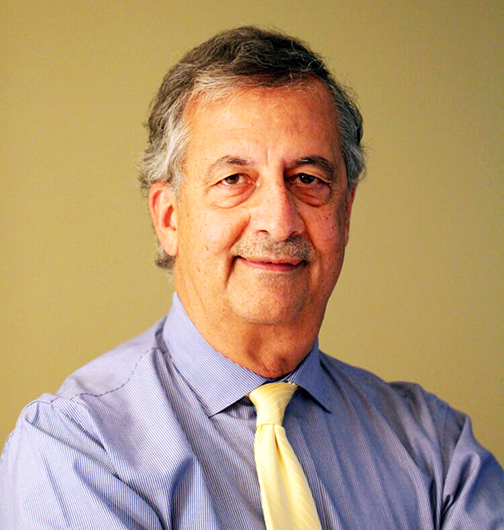
Ray Hanania is a Palestinian-American journalist, author, and radio host based in Chicago. He has been working in journalism for more than 40 years, covering politics, community issues, and the Arab-American experience. He began his career as a City Hall reporter and later became known for his columns that appear in both American and Arab media outlets.
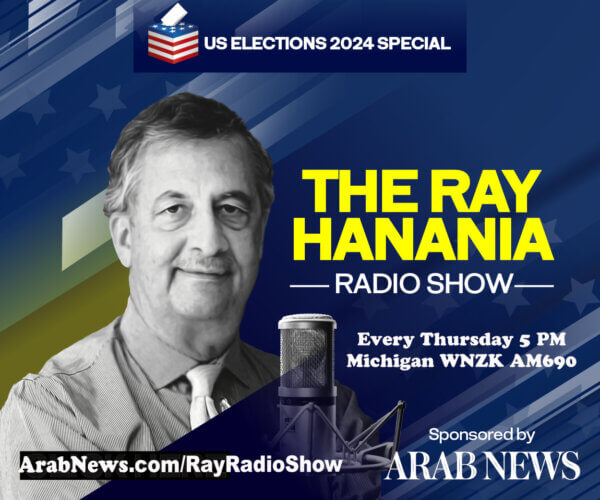
Hanania also hosts a weekly radio show on US Arab Radio, where he discusses current events and gives voice to Arab-American perspectives. In addition to journalism, he uses comedy to break down cultural barriers, performing stand-up routines that reflect his personal life and political views.
He is a U.S. military veteran and has dedicated much of his work to promoting peace, understanding, and dialogue between communities. His unique blend of journalism and humor has made him a respected and recognizable figure in both American and Middle Eastern circles.
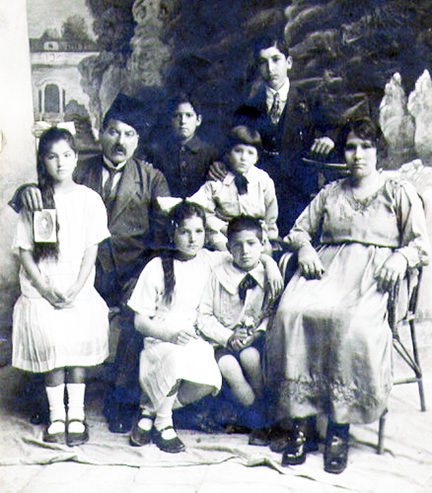
My father’s family in Jerusalem, about 1920
1. Can you tell us about your early life and how your Palestinian-American identity shaped your path into journalism?
I was born in Chicago. My father, George, is from West Jerusalem, and my mother, Georgette, is from Bethlehem. Growing up, my parents wanted me to be a doctor, like several of my cousins.
It was a very traditional Arab American home. Every year, my mother would take me and my sister to visit her family in Palestine. She would bring an empty suitcase that she would fill with Middle Eastern spices, molokhia, and other difficult-to-get food items.
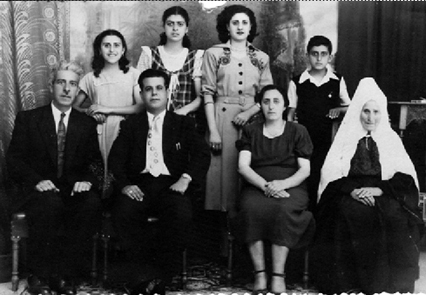
My mother’s family, around 1950
My mom was a phenomenal cook and made stuffed grape leaves at least 3 times every week. I would watch her “lif” the “wariq” for hours. I’d watch her make Arabian foods. When I grew up, I became a great Arabian food chef and frequently make stuffed grape leaves and stuffed zucchini, green peppers, and the art of making the spiced rice and lamb.
My parents often spoke of how the Israelis stole our lands, forcing my dad’s family to flee Jerusalem, where they also owned more than 32 dunum of land, Sharafat, which today has more than 160 Olive Trees near what is today the illegal racist settlement of Gilo. In 1970, the Israelis destroyed the home that was on the land, destroyed the small road to the home, and sealed the water well that they diverted away from our land to the Jewish homes in Gilo. The Israelis have prohibited us from developing the land.
Even as a young child, other children and even teachers would ask me what my “nationality” was. They constantly treated me differently, even though my English was perfect. They saw that I was a foreigner in my face.
2. What personal experiences most influenced your voice and perspective as a writer and commentator?
My dad did not want me to speak Arabic because he believed it would be a cause of discrimination. In America in the 1950s, when I was born, anti-Arab racism dominated the movie industry, books, and the news reporting. In a way, that decision helped me become a journalist as I focused on English and writing during my early teens. It allowed me to cut through the racism and later created an opportunity for me to try to make a difference.
I recognized early that no one cared about the facts in America. The public was driven by perceptions. How you looked and sounded. That’s why the Israelis were so effective. They looked and sounded American, and Americans could more easily identify with them, more so than with the Arab Americans who had the just cause and were victims of Israel’s atrocities, land theft, and murder.
3. How did your career in journalism begin, and what were the key turning points?
As I grew up, I recognized that the news media were the major driver of that anti-Arab racism. It was while in High School during my Junior Year that an English teacher saw that I had a writing talent. She asked me what I liked to do, and I told her I played lead guitar in a local rock band. She asked me to write a column on rock music for the school newspaper. It was so popular that the following year, they named me the Editor-in-Chief of the School newspaper.
I attended Northern Illinois University, studying pre-med, but after my sophomore year, I faced being drafted into the war. My Draft number was 34 (of 365), meaning I would get drafted. So, I enlisted in the U.S Air Force Active Duty in 1972. While in the Air Force, serving at an F-111 Air Attack base in Idaho that was to be dispatched to Vietnam, I was upset with the media coverage of the 1973 Arab-Israeli war, and other soldiers kept asking me, “If we are sent to defend Israel, whose side will you be on?” I told them Israel was wrong and the Arabs were trying to get justice.
I recognize how ignorant Americans were about the truth of the Middle East and Palestine, so I started writing a book called “The Palestine Irredentist: The Palestinian Fight for Justice.”
I wrote letters to many scholars like Edward Said, Ibrahim Abu-Lughod, and even to Yasir Arafat and the PLO missions around the world. When I was honorably discharged from military service in March 1975 – the war had ended, and they transferred many like me to serve in the US Air National Guard – I returned to college, attending the University of Illinois at Circle Campus in Chicago, and decided to study American politics.
I became the president of the Arab Student Organization. And later spokesman for the Arab American Congress for Palestine, established by Abu Lughod, a professor of political science at Northwestern University. In 1976, I debated Israeli Foreign Minister Abba Eban on national public television.
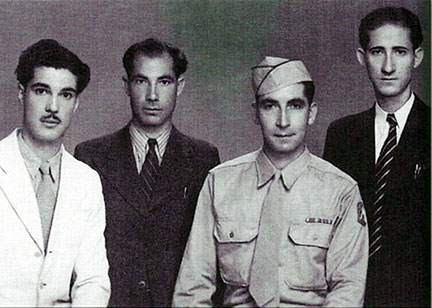
My father (3rd from left): with his brothers Edward, Khamis, George, and Farid Hanania in 1945
He tried to provoke me, saying that there was no such thing as a Palestinian. I responded on live national TV that his real name was Aubrey Solomon and he changed it to Abba Eban, and that he was born in Cape Town, South Africa. I pointed out my father’s name was George Hanania and that he was born in Jerusalem.
But while Eban could live in the Holy Land and enjoy land rights and civil rights, my father could not. I asked the audience How is that fair? I also stressed that my family name “Hanania” was a Hebrew word that means “God has been gracious” and that we probably converted to Christianity generations ago. I said it was shameful that American Christians had abandoned the Holy Land Christians like my family, who were the “real Chosen People.”
4. What challenges have you faced as an Arab-American journalist in mainstream media?
While at Circle Campus, I published my own newspaper using the GI Bill that I earned as a military veteran of the Vietnam War. The GI Bill paid me about $450 a month. I used the money to publish 10,000 copies of a monthly English-language newspaper called “The Middle Eastern Voice.” The newspaper reported on all of the activities of the Arab community in Chicagoland, and addressed anti-Arba racism in Chicago, Illinois, and in America.
While I published the newspaper, the FBI launched an investigation into who I was, even though I had a security clearance from the U.S. Military. The FBI wasted two years investigating me, and I received a copy of the report, which stated I was being investigated as a terrorist suspect, but concluded after 40-plus pages that I was merely someone who was concerned about the well-being of the Arab American community. I didn’t get a copy of the report until several years later. Their investigation fueled a horrible situation of discrimination because they spoke to neighbors, my bank, the telephone company, and employers where I worked. I lost jobs without explanation.
Back then, there was no American Arab Anti-Discrimination Committee – which I later helped found in meetings with Senator James Abourezek, Ayoub Talhami, and activist Jim Zogby.
As an activist, I got letters published in Time and Newsweek Magazine, and also in dozens of national newspapers like the New York Times, Chicago Tribune, and Los Angeles Times, defending the Palestinians and called out racism against Arabs in America.
I also wrote a letter every week to the local weekly newspaper where I lived, the Southtown Economist, on Middle East issues. I had written about 15 letters, which were lengthy, challenging the racism in the news reports. Eventually, the editor of the newspaper called me and offered me a job as a reporter for the newspaper because he said he enjoyed my writings, which were persuasive.
But he warned me, “Keep your opinions on your side of the typewriter.” And he didn’t want me to cover the Arab-Israeli conflict. I too.
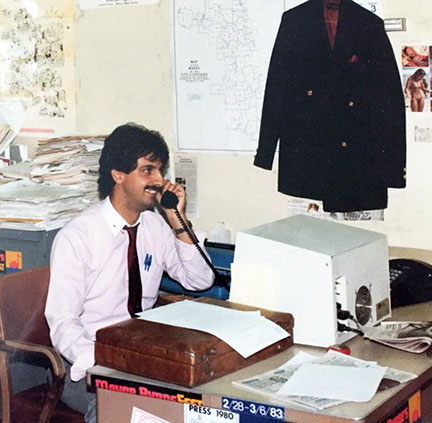
RAY HANANIA at his City Hall desk in 1983 during the term of Chicago Mayor Harold Washington
5. How do you balance objectivity with advocacy when covering sensitive political issues in your writing and Radio shows?
As a journalist, I learned that the public – the readers – are not stupid. They are smart. They see through lies and propaganda when the truth is also presented ot them. That was one of our problems as an Arab community. We have very few journalists. I was one of only a small handful of professional journalists in the 1970s and 1980s who were of Arab Heritage.
I always insisted on writing the truth about both sides, calling out Israeli terrorism but also reporting on Palestinian terrorism, putting it all in a context.
The Southtown Editors named me the City Hall reporter covering Chicago Politics in 1979. And by 1985, I was hired by the Chicago Sun-Times because of my political coverage. During my time at the Sun-Times I tried to get articles published conveying the Palestinian perspective on the conflict with Israel, but they resisted. In 1990, the newspaper planned to send a team of four Jewish reporters to cover the first Intifada. I protested that I was one of the only Palestinian professional journalists in the country and that I should be included.
But they refused to send me. I ended up taking a two-week vacation, as a protest, and traveled to Palestine to write my own stories. When I returned, I submitted five stories to the publishers and demanded they run them. They told me Arabs don’t advertise and don’t even read the newspaper. But after fighting with them, several Jewish editors supported me, and they ran the series (which I later published in my humor and reality book in 1996 called “I’m Glad I Look Like a Terrorist: Growing up Arab in America.”
The publisher became angry with the series because we received more than 300 letters from pro-Israel readers who attacked me, and one letter from an Arab reader who defended me. They fired me (making up an excuse that I had violated my objectivity) in November 1991, and I filed a lawsuit, which was settled in 1992. But it ended my journalism career. The most difficult part of that experience was that few people in the Arab American community came to my defense.
6. You’ve used humor as a tool for cultural dialogue—how did the Israeli-Palestinian Comedy Tour come about?
I had been married three times. In my first marriage, I named my daughter “Haifa,” but also gave her an American name, Carolyn. My third and current wife is Jewish. There were many Jews who supported Israel as a Jewish state but who also sympathized with the plight of the Palestinians. It turns out that Jews and Arabs get along great when they are not arguing over Palestine.
I turned to standup comedy after Sept. 11, 2001, believing that humor was a means of breaking through growing American racism against the Arabs and Palestinians, but at that time there was a growing movement os religious activists who were Muslim, and many of them told me they could not identify with a “Christian Arab who was married to a Jew.”
Often, our own community is our greatest enemy. Although we have always had a great Arab community newspaper industry (about 102 community newspapers like this one in the year 2000), most in Arabic, only recently have Arab Americans pursued mainstream journalism as a profession.
7. What role do you believe the media plays in bridging divides between communities?
The news media is the primary force that has made the persecution of Arabs, Palestinians, and Muslims a powerful and ugly reality.
We need to change that, but while the Arab community sees the bias of the news media, they don’t do enough to confront it. For example, the biggest distributors of the Chicago Sun-Times which fired me in 1991, was sold by Arab American grocery store owners in Chicago.
8. How do you view the current state of Arab-American representation in U.S. media and politics?
Our voices are growing, but many Arab activists continue to undermine our power by attacking other Arab activists and journalists like me. If I write a column defending Palestine, but it has one sentence that criticizes the Arab leadership, the Arab community always focuses on the negative and misses the significance of the column, which overall is positive. True journalism is a blend of facts, good and bad, that define the truth.
When we weigh oue negatives in an honest and fair way for the American public against the gross lies of the Israelis and anti-Arab politics, we win. But when we try to hide our faults, our errors, the American public believes criticism of Israel is propaganda and they don’t believe it.
I see this problem occurring in politics across the board on every issue. It’s just that Arab Americans, and Muslim Americans, don’t want to acknowledge it. They refuse to share their “dirty laundry” and believe it is haram.
9. What advice would you give to young Arab-Americans pursuing careers in journalism or public service?
Be journalists and tell the truth. Don’t become an activist. Write the true story and have faith that when Americans hear the truth, both sides, they always sympathize with the Arab and Muslim community.
I wrote a book called “POWER PR: AN Ethnic Activists Guide to Strategic Communications” that spells out winning strategies to overcome anti-Arab and anti-Muslim biases in the mainstream news media and in politics.
We also must document our family stories to share with those who follow us. In 2005, I wrote another book called “Arabs of Chicagoland,” which shared the story of how Arabs came to America.
10. Looking back, what are you most proud of in your career?
I am proud to have championed the moderate Arab voice to Americans, to encourage them to recognize the injustice of Israel’s racist policies.
11. What projects or goals are you currently working on that excite you?
I currently write as the U.S. Special Correspondent for the Arab News newspaper in the Gulf and write about Arab American and Muslim American stories that the mainstream American news media either refuses to cover or distorts and twists around to protect Israel.
12. How do you see the role of digital media evolving in shaping public opinion, especially within diaspora communities?
Digital media has helped open American minds to the truth, but we are often damaged when member sof our community who are so angry with the war crimes and carnage in Gaza, for example, exaggerate information. That exaggeration undermines our efforts, but it is getting less and less.
13. In your view, what are the most pressing issues facing Arab-American communities today, and how can the media help address them?
American Americans need to focus FIRST AND FOREMOST on being actively involved in their communities, not addressing Palestine first, but instead focusing on the issues that their non-Arab neighbors face. We can win over the American public by showing them that we care about them. Once they recognize us as caring about their issues, they will care about our issues.
You can’t throw the carnage of Gaza in the face of everyday Americans and then blame them, attack them, or call them names because they support politicians who support Israel. We have to be smart. Become their friend. An American will respect a “friend” but not a “stranger.” We can’t approach them as “strangers’ always talking about Palestine but never talking about local crime, rising property taxes, poor education, poor jobs and economy.
14. What legacy do you hope to leave behind through your work?
I don’t expect our community to listen to me. I am a Christian Arab and we are becoming obsolete in the Arab World. But I hope to drill home a strong message that in American politics and society, it is easy to make enemies and hard to make friends. We have to work on making friends. And in that friendship, convince Americans we are in the right.
15. Finally, what message or greeting would you like to share with Beirut Times readers around the world?
The most important message is that Arabs and Muslims in America or around the world MUST support the Arab American news media. They subscribe to American publications that attack us like the Wall Street Journal, the New York Times and their local community newspapers, which often run more anti-Arab articles than pro-Arab articles. And yet, we don’t support our Arab American community news media.
Supporting our local Arab American media is a way to express self-respect. Not subscribing or not advertising in our Arab American news media is an act of weakness that undermines our community’s voice and ability to stand up to the enemy.
* We invite readers to explore Mr. Hanania’s latest writings and insights by visiting his website at www.hanania.com.


Comments